
The program
How it works
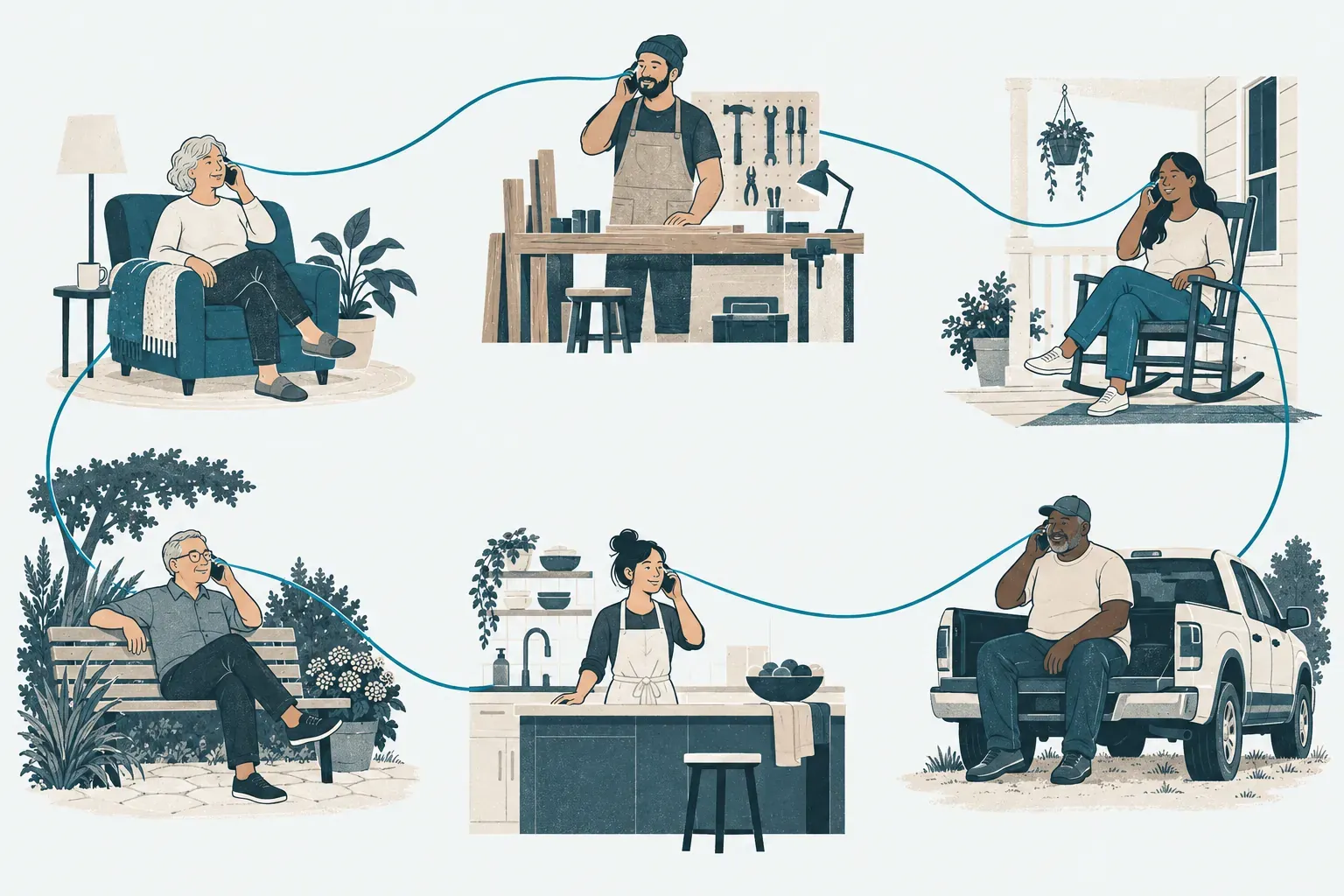
The whole design fits in three sentences. You choose a time of day. At that time the app calls you, and it calls other veterans who chose the same time. Whoever answers is connected, one to one, with a peer.
A Tuesday at 1900

1900
Your phone rings
Say the evenings are the long part of your day, after work and before sleep, when the house goes quiet. You told the app 7 p.m., so at 7 p.m. your phone rings. It is not a robocall and not a screening questionnaire. It is the app doing the one thing you asked it to do, which is get you a conversation.
A moment later
You answer, someone is there
On the line is another veteran who chose the same time and also answered. Each of you is introduced by the name you picked when you joined, and neither of you sees the other's phone number. The pairing is considered rather than random: the system favors people who share a group with you, and it learns from your feedback about who you actually click with. You talk about whatever you want. Nobody is running a protocol.
Tomorrow, and after
The habit keeps itself
Tomorrow at 7 it rings again, or only on the days you chose, or at a different time on weekends. Some calls run five minutes and some run an hour. Over weeks, familiar voices come back around, and when two people want to keep talking on purpose, the app helps them find a time you are both free. The calls are the doorway; the point is what accumulates behind it, which is a handful of people who know your voice well enough to hear when something is off in it.
Both directions
Answering is the service
Every call you answer completes somebody else's. Veterans further out from their service stay available so that a member who is newly out, newly alone, or newly struggling reaches a person rather than a voicemail. That reciprocity is not a feature we added. It is the oldest thing in the military and the reason this works at all.
Groups, not only pairs
The same machinery rings a whole group at once. A veterans organization can put its standing circle on the calendar and have every member's phone ring at the hour, with no meeting link to find, no code to type, and no volunteer permanently assigned to chasing attendance. Organizations can run groups scoped however they already work: by era of service, by branch, by post, by a shared experience their members came together around.
What this is not
Being clear about the edges is part of being trustworthy:
- Not a crisis line. If you are in crisis, or worried about a veteran who is, the Veterans Crisis Line answers 24 hours a day: dial 988 and press 1, or text 838255. We will always point you there rather than try to be it.
- Not treatment, therapy, or clinical care. The people on these calls are peers, not clinicians, and nothing here is a substitute for care from a professional.
- Not the VA. Hacktive Labs is an independent nonprofit. We are not part of the U.S. Department of Veterans Affairs, not endorsed by it, and using this has no effect on your benefits, your records, or your care.
- Not monitoring. Nobody is scoring your participation or reporting on you. Missing a call costs you nothing and triggers nothing.
- Not a social network. There is no feed, no profile to maintain, no follower count, and no advertising. The product is a phone call.
Privacy, in practice
The privacy commitments are structural rather than promises in a policy document. You go by the name you choose. Calls are bridged through the service, so your phone number is never shown to the person you are talking with unless you decide to share it. Conversations are not recorded. Any member can block any other member instantly, and a single text ends all messages from the service. The full statement is in our privacy policy.
What it costs
Nothing, to the veterans who use it. Keeping it that way is most of the reason this organization is a nonprofit rather than a company. If you want to help us get it in front of the people who need it, write to us.